
1. Discover
We scan the market for UK-relevant options that fit the declared buying intent.

Methodology
UK Shortlists is research-led and editorially managed. We publish ranked Top 4 routes for specific UK buying intents, with visible criteria, explicit trade-offs, and clear limits on what each recommendation does and does not claim.
Specific: each route has explicit selection logic.
Verifiable: evidence labels are tied to on-page support.
Maintained: changes are reviewed and timestamped.
For a concise public overview of how UK Shortlists works (Top 4 logic, evidence notes, affiliate separation, and correction discipline), start here.
Open “How UK Shortlists works”These are the main public pages that explain the standards behind UK Shortlists. Use them when you want to understand how recommendations are made, what evidence labels mean, and how corrections or disclosure concerns are handled.
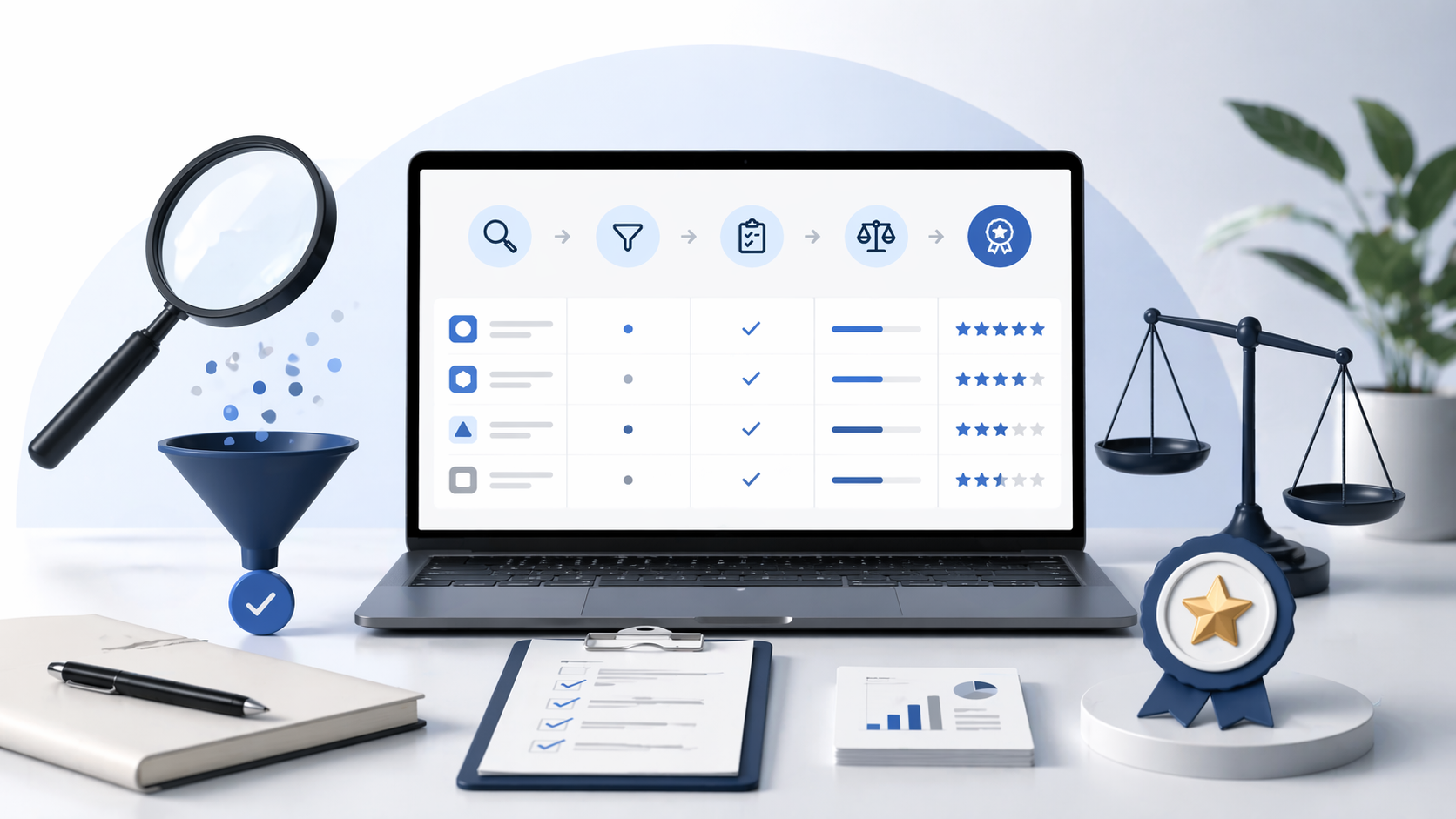
This workflow is applied to keep route decisions comparable, auditable, and clear about trade-offs.
1. Discover
We scan the market for UK-relevant options that fit the declared buying intent.

2. Filter
We remove options that fail core trust, availability, evidence, or buyer-fit checks.

3. Evaluate
We assess candidates against category-specific criteria and confidence limits.

4. Compare
We expose trade-offs so close calls are decided by reasoning, not vague preference.

5. Recommend
We publish a focused Top 4 with clear roles, caveats, and review context.
Updated 20/07/2026
Labels describe the evidence state of a page. They are not decorative badges and should only appear where the underlying support exists.
Hands-on testing: shown only when direct practical use is clearly stated on the page.
Updated: latest methodology update 20/07/2026.
A shortlist process should be repeatable and accountable. These four checkpoints anchor each route before publication.
Define reader intent
State the buying constraint and desired outcome before comparing products.
Build UK-relevant candidate set
Include options with sufficient public evidence for fair comparison.
Score and challenge
Assess fit, ownership friction, value context, and confidence limits.
Publish with accountability
Expose trade-offs, disqualifiers, ownership, and review timestamps.
We define route intent first (for example budget-first, low-friction ownership, specialist constraint, or balanced all-rounder), then build a UK-relevant candidate set with enough public documentation to evaluate fairly.
Candidates that cannot clear trust, clarity, or buyer-fit checks are removed. Top 4 roles are only assigned when each recommendation has a distinct purpose for reader decision-making.
UK Shortlists does not rank by catalogue size, sponsor preference, or commission potential.
Assessment is category-specific but follows a consistent structure: buyer-fit for the route intent, practical ownership friction, reliability risk, and value context including caveats.
Close calls are resolved with explicit trade-off notes rather than broad claims of universal superiority.
Evidence can include structured editorial comparison, specification and policy verification, owner-signal context, professional source material, named expert input where documented, and hands-on checks where direct use is explicitly stated on-page.
When evidence is limited, confidence is lowered and the limitation is shown publicly.
Weighting is set by category intent, not by a single universal scoring template. Some categories place more weight on reliability and ownership friction; others on compatibility, policy clarity, or long-term cost.
The reasoning is documented in shortlist methodology summaries and category methodology statements where available.
Disqualifiers include claims that cannot be verified, material pricing or policy ambiguity, weak UK relevance for the declared intent, or risk signals that make confidence unstable for recommendation use.
Recommendations are reviewed periodically and refreshed when material changes are identified, such as availability changes, policy updates, or confidence-impacting evidence shifts.
UK Shortlists does not claim uninterrupted real-time monitoring. It does apply visible update discipline through dated revisions and confidence-aware changes.
Affiliate relationships can support operations but do not automatically set rank order. Commercial context is disclosed and separated from recommendation rationale.
If evidence limits exist, those limits are shown even when a product has commercial value.
“Best” means best fit for the stated route intent and buyer context, with evidence strength and trade-offs made explicit.
It does not mean universally best for every buyer, budget, or use case.
Some categories include deeper evidence support where the buying decision depends on technical compatibility, policy clarity, reliability risk, or long-term ownership friction.
Audio & Creator Gear is the first category using this deeper support pattern.
Some categories publish additional methodology statements with category-specific weighting, disqualifiers, and review ownership.
Updated 12/04/2026
Updated 17/04/2026
Updated 21/04/2026
Updated 21/04/2026
Updated 21/04/2026
Updated 05/05/2026
Updated 12/04/2026
Updated 17/04/2026
Updated 17/04/2026
Updated 21/04/2026
Updated 17/04/2026
Updated 17/04/2026
Updated 17/04/2026
Updated 17/04/2026
Updated 21/04/2026
Updated 05/05/2026
Updated 17/04/2026
Updated 21/04/2026
Updated 21/04/2026
Updated 20/07/2026
Updated 21/04/2026
Updated 05/05/2026
Updated 21/04/2026
Updated 12/04/2026
Updated 17/04/2026
Updated 20/07/2026
Updated 12/04/2026
Updated 21/04/2026
Updated 12/04/2026
Updated 17/04/2026
Updated 21/04/2026
Updated 01/06/2026
Updated 21/04/2026
Updated 05/05/2026
Updated 21/04/2026
These pages describe the editorial rules, testing standards, and correction process behind each route.