
Pick 1 - Best overall
Back to Home Networking & Wi-Fi routes
Top 4 shortlist
Best Wi-Fi 7 Routers in the UK (2026): upgrade checks
Top 4 at a glance
Open a ranked result or compare the full shortlist
Affiliate links may earn commission. Check current price, stock, delivery, returns and fit on the merchant page before buying.
Pick 2 - Best budget
TP-Link Archer BE550 Wi-Fi 7 Router
Check on AmazonPick 3 - Best premium
ASUS RT-BE88U Wi-Fi 7 Router
Check on AmazonPick 4 - Best specialist or alternative
TP-Link Deco BE65 (3-pack) Wi-Fi 7 Mesh Router System
Check on AmazonLooking for a Wi-Fi 7 router? Compare compatible devices, wired ports, placement and mesh needs before deciding whether a next-generation upgrade fits your home.
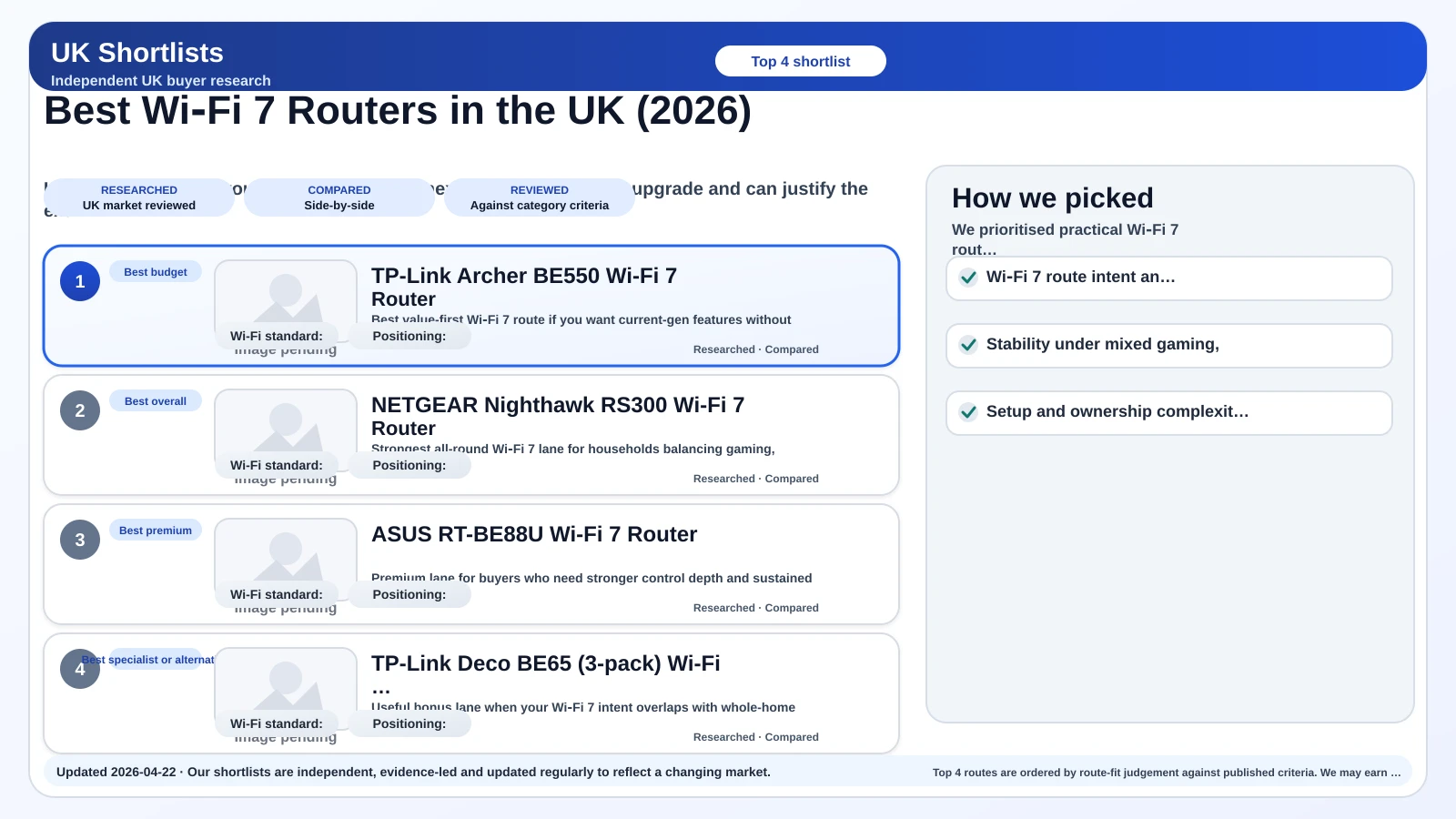
Who this is for: Best Wi-Fi 7 routers route all-rounder lane.
Winner: NETGEAR Nighthawk RS300 Wi-Fi 7 Router .
Why it wins: Strongest all-round Wi‑Fi 7 lane for households balancing gaming, streaming, and heavy daily device loads.
Smarter alternative when: Best Wi-Fi 7 routers route budget lane (TP-Link Archer BE550 Wi-Fi 7 Router)
Start here if one specific requirement matters more than broad all-round value.
Published: 22/04/2026 · Merchant check: 22/04/2026 · Spec check: 19/07/2026 · Last significant change: 19/07/2026
Latest logged check is 8 days old. Category window: 180–180 days.
Check live retailer details before buying.
Dates reflect scheduled editorial refresh work and recorded changes, not continuous live monitoring.
Use this when one specific constraint drives the choice
If this feels too narrow, pressure-test against one main buying route before final checkout.
Find the right route first
Quick route check for Wi-Fi 7 router searches
Use this if Wi-Fi 7 compatibility and multi-gig readiness are the buying drivers. If current-device value or large-home coverage matters more, compare that route first.
Decision surface
Start with the winner, then compare the Top 4
Winner
NETGEAR Nighthawk RS300 Wi-Fi 7 Router
Strongest all-round Wi‑Fi 7 lane for households balancing gaming, streaming, and heavy daily device loads.
Check before buying
Confirm your client devices support Wi‑Fi 7 before paying a premium for next-gen capability.
Trust and route check
Free Top 4 guidance, with clear limits
Free to use. Top 4 by design. Evidence-led, with no lab-use claim unless clearly stated. UK Shortlists may earn affiliate commission from qualifying on-site links, but this should not change the shortlist order. Check current price, availability, delivery, returns and terms before buying.
Not sure this is the right page? Route Finder suggests a starting shortlist route. It does not change product rankings.
Not for you if / Check before buying
Use this decision layer to rule out poor-fit picks early and avoid expensive mismatches.
Avoid if
- Your devices do not support Wi‑Fi 7 and you are mainly chasing future-proofing without a near-term need.
- Your main problem is thick walls, dead zones, poor router placement, or ISP instability rather than router generation.
- You expect guaranteed speed, latency, gaming, or whole-home coverage gains from the Wi‑Fi 7 label alone.
Dealbreakers
- Your broadband plan, modem/ONT, Ethernet cables, client devices, or backhaul cannot use the router’s headline features.
- Firmware/security-update policy, app/subscription controls, or warranty support are unclear before purchase.
- Whole-home coverage remains unlikely from one router because of property layout, wall materials, or router placement.
Check before buying
- Confirm your client devices support Wi‑Fi 7 before paying a premium for next-gen capability.
- Check WAN/LAN port speeds, Ethernet cable category, mesh/backhaul plans, modem/bridge mode, and ISP setup requirements.
- Map router placement, thick walls, dead zones, device load and whether a mesh kit beats one standalone router for your home.
Choose another route if
- You need best value now rather than next-gen headroom; compare Wi‑Fi 6 first.
- You need wider property coverage; compare mesh or thick-wall routes before standalone Wi‑Fi 7.
- You need business-grade networking, managed access points, or router/firewall administration rather than consumer-router guidance.
Decision summary
Start here
Review basis updated 19/07/2026
- Best for
- Best Wi-Fi 7 routers route all-rounder lane
- Start with
- NETGEAR Nighthawk RS300 Wi-Fi 7 Router
- Choose the alternative if
- Best Wi-Fi 7 routers route budget lane (TP-Link Archer BE550 Wi-Fi 7 Router)
- Check before buying
- Confirm current merchant pricing and delivery details before checkout. Substantive review 19/07/2026 · Merchant/detail checks 22/04/2026.
Compare next: Best Wi‑Fi 6 Routers in the UK (2026)
Route review notes
Decision notes before you open merchant pages
Use this route when you specifically want a Wi‑Fi 7 router and need a clear upgrade check before paying for a next-generation model.
Start by identifying the actual bottleneck. Your client devices, broadband plan, modem or ONT, Ethernet ports, wall layout and router placement can matter more than the Wi‑Fi generation on the box. If coverage is the real issue, compare Best Budget Mesh Wi‑Fi Systems in the UK (2026) before assuming a standalone Wi-Fi 7 router will solve it.
Check upgrade fit before comparing merchants
- Confirm that the devices you expect to benefit actually support Wi-Fi 7.
- Check the WAN and LAN ports, existing cables, modem or ONT setup, and whether you need wired backhaul for the rooms that matter.
- Decide whether you need one router, a mesh system or a placement change before comparing Top 4 roles.
The comparison helps narrow a route. It does not promise a speed, latency, gaming or coverage result in your home.
Why the winner wins (evidence basis)
The All-Rounder wins because it offers the strongest balance of Wi‑Fi 7 headroom, mixed-device stability, setup practicality, firmware/support confidence, and UK value for households that can actually use next-gen capability. This call is based on documented product records and shortlist scoring notes rather than guaranteed speed, latency, or coverage claims.
What would change the winner
A winner change is likely if source-backed evidence shows another router handles Wi‑Fi 7 compatibility, multi-gig readiness, firmware support, setup simplicity, and UK value better at a similar spend tier.
Known limitations in this route
- Evidence depth is stronger on published specs and structured source notes than on direct in-house RF, latency, or throughput testing.
- Availability and deal prices can change faster than editorial review cycles; check live listings before purchase.
- Real gains depend on Wi‑Fi 7 client devices, router placement, interference, ISP service, wired backhaul, and firmware maturity.
Compare next or return to hub
Use one adjacent route to pressure-test this decision, then return to the category hub to finalise fit.
Decision accelerator
Use this when one specific constraint drives the choice
If this feels too narrow, pressure-test against one main buying route before final checkout.
Lead pick decision
Start with NETGEAR Nighthawk RS300 Wi-Fi 7 Router. Strongest all-round Wi‑Fi 7 lane for households balancing gaming, streaming, and heavy daily device loads.
Pressure-test this choice once
Stop reading and click out once one pick clearly matches your specialist requirement better than the generalist alternative.
Next action
Ready to check current merchant pricing on this recommended route?
Use our quick shortlist summary to pick the right fit for your needs.
Specialist route: narrowed for one priority need.
Affiliate link: we may earn a commission if you buy through this link. Check retailer details before buying. Retailer is the source of current price and availability. Rankings remain editorially independent (latest reviewer pass: 19/07/2026). Disclosure details.
Newsletter
Not buying today?
Save this route for later buying checks and seasonal shortlist updates. We do not send live-price promises or fake urgency.
Disclosure
Last reviewed: 19/07/2026
As an Amazon Associate, we may earn from qualifying purchases when you use outbound links, at no extra cost.
Rankings are set from route criteria and evidence notes, not by commission size.
We assign Budget, All-Rounder, Premium, and Bonus lanes from route-fit scoring, practical trade-offs, and value-by-tier checks.
Read more about how UK Shortlists makes money, merchant checks, and how corrections are handled.
Before you checkout
Check the route, then check the merchant page.
Use the shortlist for fit, caveats and comparison. Use Price Watch and Amazon Seller Check to verify final price, seller, delivery, returns and warranty details before buying NETGEAR Nighthawk RS300 Wi-Fi 7 Router.
Merchant terms can change. UK Shortlists does not promise live price, stock, delivery speed or cheapest-seller outcomes.
Reader request
Need this guide refreshed?
Tell us what changed, what looks stale, or what you were trying to decide. Requests are reviewed privately as editorial signals.
Context: Best Wi-Fi 7 Routers in the UK (2026): upgrade checks
Requests do not automatically change rankings, product selections, merchant links, or recommendations. They help identify useful corrections, refreshes, and missing buyer questions.
For product teams
Send a product for honest review consideration
A sample never guarantees inclusion, a positive review, an award, or a ranking. If we use a gifted, discounted, or loaned sample, we disclose that basis and write honestly about fit, limits, and trade-offs.
Submit a review sampleUse this shortlist as a decision tool
Action model: compare Top 4 picks, save/share the route, then continue to merchant when ready.
Decision proof and evidence context
Evidence snapshot
Evidence support, not a product rating.
This panel summarises the evidence support available for this route. It is designed to show what to verify next, not to score products or replace current merchant/manufacturer checks.
All-shortlist evidence layer
Source support
Medium
Route evidence records are present, but category-level source verification may still be incomplete.
Evidence coverage
Adequate
Evidence covers the main route criteria, with limitations stated.
Refresh age
Recently reviewed
22/04/2026 — Review date is visible, but current price, stock and merchant terms still need checking.
Specification clarity
Partial
Main specs are visible, but some model, capacity or bundle details still need buyer verification.
Source boundary
Micro-proof signals describe evidence support and shopping-path context only. They do not prove product quality, safety, durability, live price, stock, ratings, review counts or universal suitability.
Review basis
Evidence-supported comparison · Updated 19/07/2026.
Structured comparison with explicit criteria, trade-offs, source signals, and evidence-backed winner rationale.
Limitations
- No live price, stock, rating or review-count proof is provided by this panel.
- No universal first-party product-use or lab-verification proof is claimed for every ranked model.
- Verify current merchant and manufacturer details before checkout.
Decision proof
Evidence basis for this route
Review basis updated 19/07/2026
Review basis
Evidence-supported comparison
Structured comparison with explicit criteria, trade-offs, source signals, and evidence-backed winner rationale.
First-party assessment status: Not claimed for this route
Last reviewed: 19/07/2026 · Merchant checks 22/04/2026
Why these criteria matter
We prioritised practical Wi‑Fi 7 route fit, mixed-load stability, multi-gig readiness, setup friction, and UK value tiers before assigning Top 4 roles.
How this category was assessed
- Wi‑Fi 7 route intent and upgrade-value fit
- Stability under mixed gaming, streaming, and smart-home traffic
- Setup and ownership complexity in real homes
- Multi-gig WAN/LAN, client-device, and backhaul readiness
Reader proof checkpoints
- Buyer intent is defined before the Top 4 is treated as useful.
- Ranking logic is tied to stated criteria, not catalogue size or commission alone.
- Trade-offs and route-switch prompts are shown before final merchant checks.
- Evidence limits stay visible where direct product checks, live monitoring or full-market coverage are not claimed.
Claim boundaries
- This route is based on documented evidence and caveats, not first-party product-use or controlled-environment verification.
- Merchant/detail checks are recorded to 22/04/2026; final merchant pages still need checking before buying.
- This panel is decision support, not a guarantee that one product is universally best for every buyer.
What was not checked
- UK Shortlists has not performed first-party-use or laboratory verification for every model in this shortlist; recommendations are evidence-led and caveat-based.
Route snapshot
Route decision snapshot
Looking for a Wi-Fi 7 router? Compare compatible devices, wired ports, placement and mesh needs before deciding whether a next-generation upgrade fits your home. This route is intended as a first-click decision page before deeper product-specific research.
- Best starting point: NETGEAR Nighthawk RS300 Wi-Fi 7 Router - Strongest all-round Wi‑Fi 7 lane for households balancing gaming, streaming, and heavy daily device loads.
- Lead pick summary: For Best Wi-Fi 7 routers route all-rounder lane. Winner: NETGEAR Nighthawk RS300 Wi-Fi 7 Router. Why: Strongest all-round Wi‑Fi 7 lane for households balancing gaming, streaming, and heavy daily device loads.. Smarter alternative: TP-Link Archer BE550 Wi-Fi 7 Router when Best Wi-Fi 7 routers route budget lane.
- Pressure-test next: If your priorities differ, pressure-test this winner against Best Wi‑Fi 6 Routers in the UK (2026).
Evidence detail
Evidence summary
Merchant/detail checks last reviewed 22/04/2026
Criteria used
- Wi‑Fi 7 route intent alignment
- Practical next-gen upgrade framing versus Wi‑Fi 6 alternatives
- Value-by-tier and coverage caveat calibration
Evidence types used
- Merchant listing continuity checks
- Independent review trade-off context
- Route-specific evidence notes claim verification
Excluded or deprioritized
- Travel-router products not designed for fixed-home primary networking
- Generic speed-claim framing that implies guaranteed in-home outcomes
- Claims implying Wi‑Fi 7 alone solves ISP, client-device, or home-layout bottlenecks
Evidence boundary
UK Shortlists has not performed first-party-use or laboratory verification for every model in this shortlist; recommendations are evidence-led and caveat-based.
Why the overall winner won
The All-Rounder won by balancing next-gen performance uplift, device-load headroom, setup burden, and value better than lower and higher spend extremes.
Evidence and product-data context
Evidence labels explain what supports this shortlist; product and merchant details can change after review. See Review Basis, Product Data Policy, and Merchant Checks.
Recommendation strength
How this framework worksThis route is credible for shortlist decisions with explicit caveats around real-home variability, device compatibility, and Wi‑Fi 7 upgrade value.
Change log
Substantive shortlist changes only. Minor copy or layout edits are not logged here.
-
19/07/2026
Refined the Wi-Fi 7 router decision path around compatible devices, wired setup and whole-home fit, corrected the route card asset, and added a budget-mesh handoff. Product roles and merchant destinations are unchanged.
-
13/06/2026
Added Search Console-led Wi-Fi 7 query language and route-choice support for the second money-page optimisation batch.
-
12/06/2026
Search-opportunity pass sharpened Wi‑Fi 7 upgrade intent, mesh-vs-router checks, and the CTA while avoiding guaranteed speed, latency or coverage claims.
-
05/05/2026
Replaced generic proof-depth copy and copied setup fields with Wi‑Fi 7 router-specific winner rationale, limitations, and setup caveats.
-
22/04/2026
Published specialist Wi‑Fi 7 route with route-linked ready evidence notes and validated Top 4 mapping.
Primary decision panel
Top 4 picks in ranked order
Start with the winner, then scan trade-offs and buyer fit before opening merchant links.
Pick 1
Overall winner
Best overall
NETGEAR Nighthawk RS300 Wi-Fi 7 Router
Verdict
Strongest all-round Wi‑Fi 7 lane for households balancing gaming, streaming, and heavy daily device loads.
Affiliate merchant link. Check current price, stock, delivery and returns before buying.
Approx. price: GBP 279.00
Evidence & Support
Data: Not yet verified Specs: Not yet verified
Warranty & Support
- Warranty: Not yet verified
- Support: Not yet verified
Highlights
- Balanced Wi-Fi 7 lane for households seeking practical next-gen coverage.
- Useful all-round fit where mixed-device load is the main constraint.
Drawbacks
- Still a premium-adjacent spend versus Wi-Fi 6 routes.
Buyer fit
Best for
- Best Wi-Fi 7 routers route all-rounder lane
- Homes with high concurrent traffic and broad coverage needs
Not for you if
- Small flats that do not need Wi-Fi 7-class headroom
Next action
Outbound merchant link (opens merchant site)
Check lead pick on AmazonPick 2
Best budget
TP-Link Archer BE550 Wi-Fi 7 Router
Verdict
Best value-first Wi‑Fi 7 route if you want current-gen features without jumping straight to flagship spend.
Affiliate merchant link. Check current price, stock, delivery and returns before buying.
Approx. price: GBP 219.00
Evidence & Support
Data: Not yet verified Specs: Not yet verified
Warranty & Support
- Warranty: Not yet verified
- Support: Not yet verified
Highlights
- Accessible Wi-Fi 7 step-up route for buyers moving beyond Wi-Fi 6.
- Practical middle tier for mixed gaming, streaming, and smart-home usage.
Drawbacks
- Higher spend than strong Wi-Fi 6 all-rounder routers.
Buyer fit
Best for
- Best Wi-Fi 7 routers route budget lane
- Households wanting a current-gen router without flagship spend
Not for you if
- Buyers focused on lowest-cost router replacement
Next action
Outbound merchant link (opens merchant site)
Check on AmazonPick 3
Best premium
ASUS RT-BE88U Wi-Fi 7 Router
Verdict
Premium lane for buyers who need stronger control depth and sustained headroom for demanding networks.
Affiliate merchant link. Check current price, stock, delivery and returns before buying.
Approx. price: GBP 329.00
Evidence & Support
Data: Not yet verified Specs: Not yet verified
Warranty & Support
- Warranty: Not yet verified
- Support: Not yet verified
Highlights
- Premium Wi-Fi 7 route with stronger configuration headroom for advanced users.
- Useful step-up for demanding gaming and smart-home device density.
Drawbacks
- Price tier is difficult to justify for modest home loads.
Buyer fit
Best for
- Best Wi-Fi 7 routers route premium lane
- Buyers prioritising stronger control and sustained headroom
Not for you if
- Entry-budget buyers replacing basic ISP routers
Next action
Outbound merchant link (opens merchant site)
Check on AmazonPick 4
Best specialist or alternative
TP-Link Deco BE65 (3-pack) Wi-Fi 7 Mesh Router System
Verdict
Useful bonus lane when your Wi‑Fi 7 intent overlaps with whole-home multi-node coverage needs.
Affiliate merchant link. Check current price, stock, delivery and returns before buying.
Approx. price: GBP 399.00
Evidence & Support
Data: Not yet verified Specs: Not yet verified
Warranty & Support
- Warranty: Not yet verified
- Support: Not yet verified
Highlights
- Strong fallback lane when Wi-Fi 7 buyers need multi-node whole-home consistency.
- Useful for larger homes where single-router placement is a hard limitation.
Drawbacks
- Higher total-system spend and larger setup footprint than standalone routers.
Buyer fit
Best for
- Best Wi-Fi 7 routers route bonus lane
- Homes where Wi-Fi 7 intent overlaps with mesh coverage needs
Not for you if
- Small homes where single-router coverage is already stable
Next action
Outbound merchant link (opens merchant site)
Check on AmazonTop 4 comparison
Side-by-side comparison using only sourced shortlist decision fields.
1. NETGEAR Nighthawk RS300 Wi-Fi 7 Router
- Pick role:Best overall
- Best for:Best Wi-Fi 7 routers route all-rounder lane
- Avoid if:Small flats that do not need Wi-Fi 7-class headroom
- Key trade-off:Still a premium-adjacent spend versus Wi-Fi 6 routes.
2. TP-Link Archer BE550 Wi-Fi 7 Router
- Pick role:Best budget
- Best for:Best Wi-Fi 7 routers route budget lane
- Avoid if:Buyers focused on lowest-cost router replacement
- Key trade-off:Higher spend than strong Wi-Fi 6 all-rounder routers.
3. ASUS RT-BE88U Wi-Fi 7 Router
- Pick role:Best premium
- Best for:Best Wi-Fi 7 routers route premium lane
- Avoid if:Entry-budget buyers replacing basic ISP routers
- Key trade-off:Price tier is difficult to justify for modest home loads.
4. TP-Link Deco BE65 (3-pack) Wi-Fi 7 Mesh Router System
- Pick role:Best specialist or alternative
- Best for:Best Wi-Fi 7 routers route bonus lane
- Avoid if:Small homes where single-router coverage is already stable
- Key trade-off:Higher total-system spend and larger setup footprint than standalone routers.
| Pick | Pick role | Best for | Avoid if | Key trade-off | Merchant action |
|---|---|---|---|---|---|
| 1. NETGEAR Nighthawk RS300 Wi-Fi 7 Router | Best overall | Best Wi-Fi 7 routers route all-rounder lane | Small flats that do not need Wi-Fi 7-class headroom | Still a premium-adjacent spend versus Wi-Fi 6 routes. | Check winner price |
| 2. TP-Link Archer BE550 Wi-Fi 7 Router | Best budget | Best Wi-Fi 7 routers route budget lane | Buyers focused on lowest-cost router replacement | Higher spend than strong Wi-Fi 6 all-rounder routers. | Check merchant price |
| 3. ASUS RT-BE88U Wi-Fi 7 Router | Best premium | Best Wi-Fi 7 routers route premium lane | Entry-budget buyers replacing basic ISP routers | Price tier is difficult to justify for modest home loads. | Check merchant price |
| 4. TP-Link Deco BE65 (3-pack) Wi-Fi 7 Mesh Router System | Best specialist or alternative | Best Wi-Fi 7 routers route bonus lane | Small homes where single-router coverage is already stable | Higher total-system spend and larger setup footprint than standalone routers. | Check merchant price |
What changes the winner
Winner logic
Strongest all-round Wi‑Fi 7 lane for households balancing gaming, streaming, and heavy daily device loads.
When to pick a different route
If your priorities differ, pressure-test this winner against Best Wi‑Fi 6 Routers in the UK (2026).
Methodology support
How we chose
We prioritised practical Wi‑Fi 7 route fit, mixed-load stability, multi-gig readiness, setup friction, and UK value tiers before assigning Top 4 roles.
- Step 1: Wi‑Fi 7 route intent and upgrade-value fit
- Step 2: Stability under mixed gaming, streaming, and smart-home traffic
- Step 3: Setup and ownership complexity in real homes
- Step 4: Multi-gig WAN/LAN, client-device, and backhaul readiness
- Step 5: Value spread across budget, all-rounder, and premium lanes
Category evaluation moat
This is an editorial evaluation framework based on practical comparison factors, trade-off logic, and category-specific buyer fit.
-
Day-to-day performance for normal use
Most buyers need reliable everyday value, not edge-case specs.
Weight: High influence
-
Practical ownership friction
Setup, upkeep, and support burden can erase headline value quickly.
Weight: High influence
-
Value by UK spend tier
A higher price only wins if the practical return is clear.
Weight: High influence
-
Fit to specific buyer constraints
Budget limits and specialist needs can outweigh broad all-round scoring.
Weight: Secondary influence
Why the winner wins
Rank #1 is the strongest all-round starting point for the highest number of UK buyers.
When budget is smarter
Use the budget route when spend ceiling is fixed and compromises are explicit, acceptable, and likely to stay acceptable after 3-6 months.
When specialist is worth it
Use the specialist route when one requirement clearly dominates your decision more than broad value.
What changes the winner
A different product would win if either your spend band changes materially or one non-negotiable requirement becomes dominant.
FAQs & alternatives
Does this page claim first-party-use or laboratory verification?
No. This page is a desk-based shortlist built from product records, published specifications, and source notes. Unless the methodology section says otherwise, it does not claim UK Shortlists hands-on use or laboratory verification.
Is Wi‑Fi 7 always worth buying in 2026?
Not always—many homes still get excellent value from strong Wi‑Fi 6 routers.
Should I choose the Premium pick by default?
Only if your device load and control needs genuinely justify the extra cost.
Will Wi‑Fi 7 make my broadband faster?
No. It can improve local wireless capability for compatible devices, but it cannot exceed your broadband plan or fix ISP-side limits.
Also consider
- If you want stronger value before going next-gen, compare [Best Wi‑Fi 6 Routers in the UK (2026)](/shortlists/best-wifi-6-routers-uk-2026).
- If your Recommended is dead-zone remediation rather than standard upgrades, compare [Best Wi‑Fi Extenders in the UK (2026)](/shortlists/best-wifi-extenders-uk-2026).
Next action
Ready to complete your shortlist decision?
Use our quick shortlist summary to pick the right fit for your needs.
Specialist route: narrowed for one priority need.
Affiliate link: we may earn a commission if you buy through this link. Check retailer details before buying. Retailer is the source of current price and availability. Rankings remain editorially independent (latest reviewer pass: 19/07/2026). Disclosure details.
Editorial accountability
Clear public ownership for who compiled this shortlist, who reviewed it, what evidence label applies, and how corrections are handled.
Compiled-route scope
1515
routes currently attributed to this compiler.
Review-route scope
1515
routes currently attributed to this reviewer.
Route family
Home Networking & Wi-Fi
59 routes in this family.
Written / compiled by
Editorial team
Responsibility: Owns shortlist compilation, evidence framing, quality checks, corrections, and publication decisions.
Scope: A transparent editorial system for reducing buying complexity without claiming hands-on testing or specialist credentials that have not been documented.
- Evidence method: Defines the reader intent and material buying constraints before comparing options.
- Evidence method: Uses official documentation, product records, merchant terms, category evidence, and other attributable sources.
Reviewed by
Editorial team
Scope: A transparent editorial system for reducing buying complexity without claiming hands-on testing or specialist credentials that have not been documented.
- Review check: Compiles recommendations against the declared route intent and category criteria.
- Review check: Checks source support, claim boundaries, disclosure, and merchant-link handling.
- Review check: Records substantive updates and corrects material factual errors.
- Evidence method: Defines the reader intent and material buying constraints before comparing options.
- Evidence method: Uses official documentation, product records, merchant terms, category evidence, and other attributable sources.
Public coverage scope
Home and kitchenconsumer technologywork and productivitytravel planningtelecom and services
Last reviewed: 19/07/2026
Last updated: 19/07/2026
Review basis checked: 19/07/2026
Review basis: Evidence-supported comparison
Reviewed against the measured Wi-Fi 7 router query with clearer compatibility, wired-port, placement and mesh-versus-router checks while keeping in-home outcome limits visible.
Structured comparison with explicit criteria, trade-offs, source signals, and evidence-backed winner rationale.
Unless a page explicitly documents first-party product use or a named external expert review, treat this as evidence-led decision support rather than hands-on lab testing.
Organisational attribution describes the documented UK Shortlists process. It does not imply a physical testing laboratory, a large editorial staff, professional endorsement, or named expert review.
Policies: Editorial, Testing & Evidence, Review Basis, Expert Review Framework, Claims We Do Not Make, Corrections, Buyer Help, Contact.
Found a stale detail, broken merchant link, unsupported claim, or disclosure issue? Use Editorial Contact and include the page URL plus the affected product or claim.
Compare before finalising this route
Use one adjacent route to pressure-test your shortlist, then return to finalise your pick.
Compare this next: Best Wi‑Fi 6 Routers in the UK (2026)