
UK buying shortlist
Four Car Battery Chargers and Maintainers Worth Comparing (2026)
Written by Outdoors & Mobility Desk Outdoors and mobility editorial desk · Car Battery Care beat · reviewed 03/09/2026
Choose this shortlist if you need to compare four distinct charger jobs: 12V lead-acid maintenance, 4A multi-chemistry charging, higher-output 12V/24V charging and compact 6V/12V mixed-chemistry support.
Quick answer · Top 4
Compare all four before checking exact sources and retailer options
Retailer buttons are affiliate links and may earn commission. Product details explain identity, specifications and buying checks; they do not confirm live price, stock or universal fit.
Pick 1 - All-Rounder
CTEK MXS 5.0 UK Car Battery Charger and Maintainer
Best for:Drivers with a compatible 12V lead-acid battery who want a documented charge and maintenance range.
Trade-off:It is not a lithium charger and does not support 6V or 24V batteries.
Check CTEK MXS 5.0 UK Car Battery Charger and Maintainer on AmazonPick 2 - Budget
Ring RSC904 SMARTCHARGE 4 Car Battery Charger
Best for:Buyers needing a compact 6V or 12V charger with documented modes for several common lead-acid types and supported lithium-ion.
Trade-off:Broad chemistry wording does not remove the need to confirm the exact lithium battery and battery-management requirements.
Open shortlist reviewPick 3 - Premium
Ring RSC908 SMARTCHARGE 8 Car Battery Charger
Best for:Buyers with a compatible larger or 24V battery setup who can justify 8A output.
Trade-off:Higher output and 24V capability add no value for an incompatible small battery and make mode selection more important.
Open shortlist reviewPick 4 - Specialist
NOCO Genius 5 Car Battery Charger and Maintainer
Best for:Buyers who need one compact charger for supported 6V or 12V lead-acid and lithium-ion modes.
Trade-off:Mode choice and lithium battery-management compatibility still require exact manual checks.
Check NOCO Genius 5 Car Battery Charger and Maintainer on AmazonUse-context outdoor voice
Frames outdoor and mobility choices around conditions, storage and compatibility rather than broad performance promises.
Outdoors & Mobility Desk buyer lens: Start with where, when and how the item will be used before weighing its headline features. Check the exact storage, vehicle, destination or use-condition requirement before checkout.
Decision checks: conditions and storage · vehicle or destination fit · current rules and source checks
The shortlist
Four options, with the trade-offs visible
Use the fit, limitations and checkout checks before opening a retailer page. Confirm the current price, stock, delivery and returns with the retailer.
Pick 1
First comparison point
All-Rounder
CTEK MXS 5.0 UK Car Battery Charger and Maintainer
Verdict
CTEK MXS 5.0 UK Car Battery Charger and Maintainer is for drivers with a compatible 12V lead-acid battery who want a documented charge and maintenance range. The official UK item 56-975 page publishes 5A output, lead-acid chemistry coverage, temperature compensation and capacity guidance up to 110Ah charging and 160Ah maintenance. Trade-off: It is not a lithium charger and does not support 6V or 24V batteries. Check before buying: Confirm the battery is supported 12V lead acid and within the maker capacity guidance before connecting.
Affiliate retailer link. Check current price, stock, delivery and returns before buying.

Highlights
- CTEK publishes 5A output, lead-acid chemistry coverage, temperature compensation and capacity guidance up to 110Ah charging and 160Ah maintenance.
Drawbacks
- It is not a lithium charger and does not support 6V or 24V batteries.
Buyer fit
Best for
- Drivers with a compatible 12V lead-acid battery who want a documented charge and maintenance range.
Not for you if
- It is not a lithium charger and does not support 6V or 24V batteries.
Check before buying
- Confirm the battery is supported 12V lead acid and within the maker capacity guidance before connecting.
Pick 2
Budget
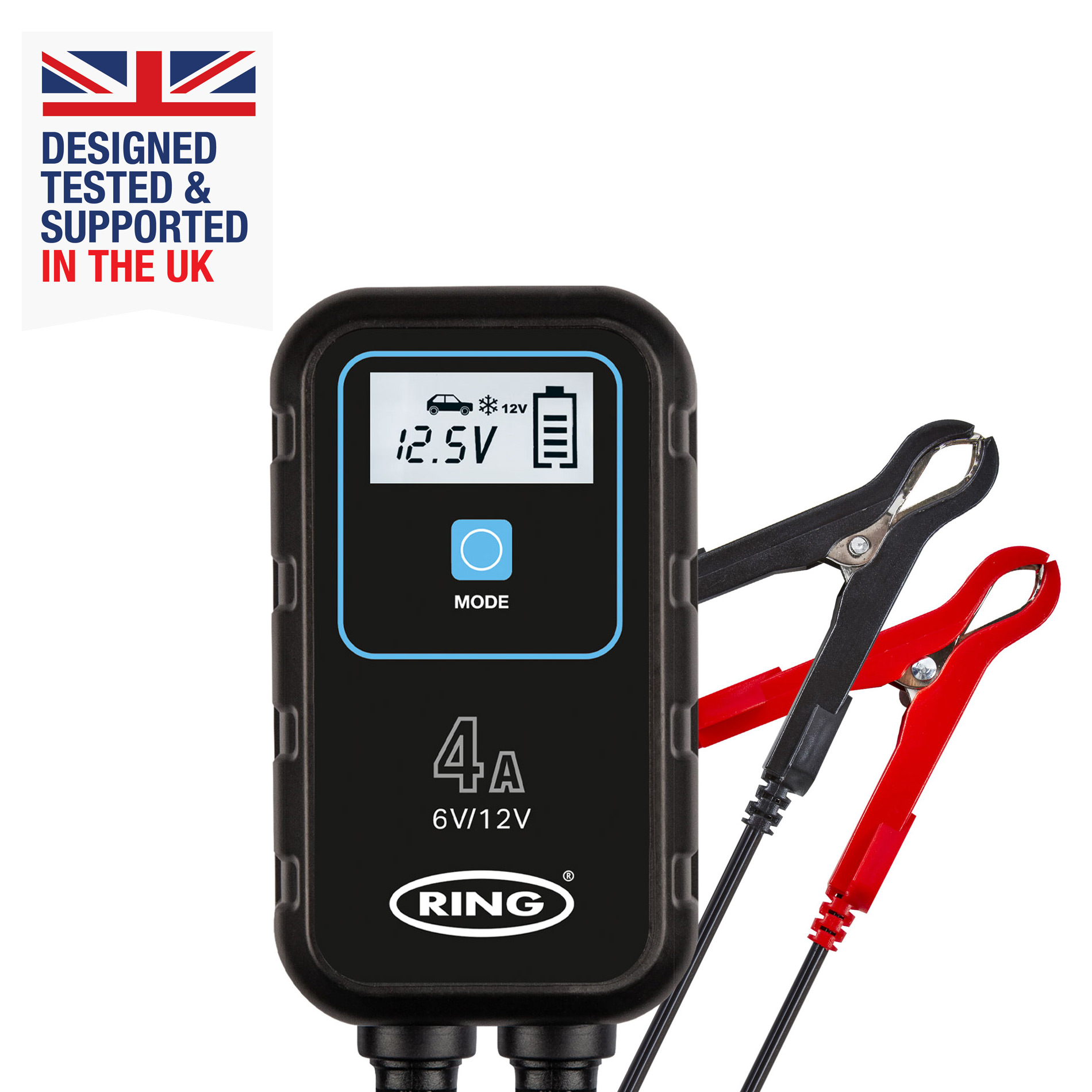
Ring RSC904 SMARTCHARGE 4 Car Battery Charger
Verdict
Ring RSC904 SMARTCHARGE 4 Car Battery Charger is for buyers needing a compact 6V or 12V charger with documented modes for several common lead-acid types and supported lithium-ion. Ring publishes 4A output, nine-stage charging, IP65 protection and clips plus O-ring connectors. Trade-off: Broad chemistry wording does not remove the need to confirm the exact lithium battery and battery-management requirements. Check before buying: Match the selected mode to the exact battery label and manual; do not infer universal lithium compatibility.
Highlights
- Ring publishes 4A output, nine-stage charging, IP65 protection and clips plus O-ring connectors.
Drawbacks
- Broad chemistry wording does not remove the need to confirm the exact lithium battery and battery-management requirements.
Buyer fit
Best for
- Buyers needing a compact 6V or 12V charger with documented modes for several common lead-acid types and supported lithium-ion.
Not for you if
- Broad chemistry wording does not remove the need to confirm the exact lithium battery and battery-management requirements.
Check before buying
- Match the selected mode to the exact battery label and manual; do not infer universal lithium compatibility.
Pick 3
Premium
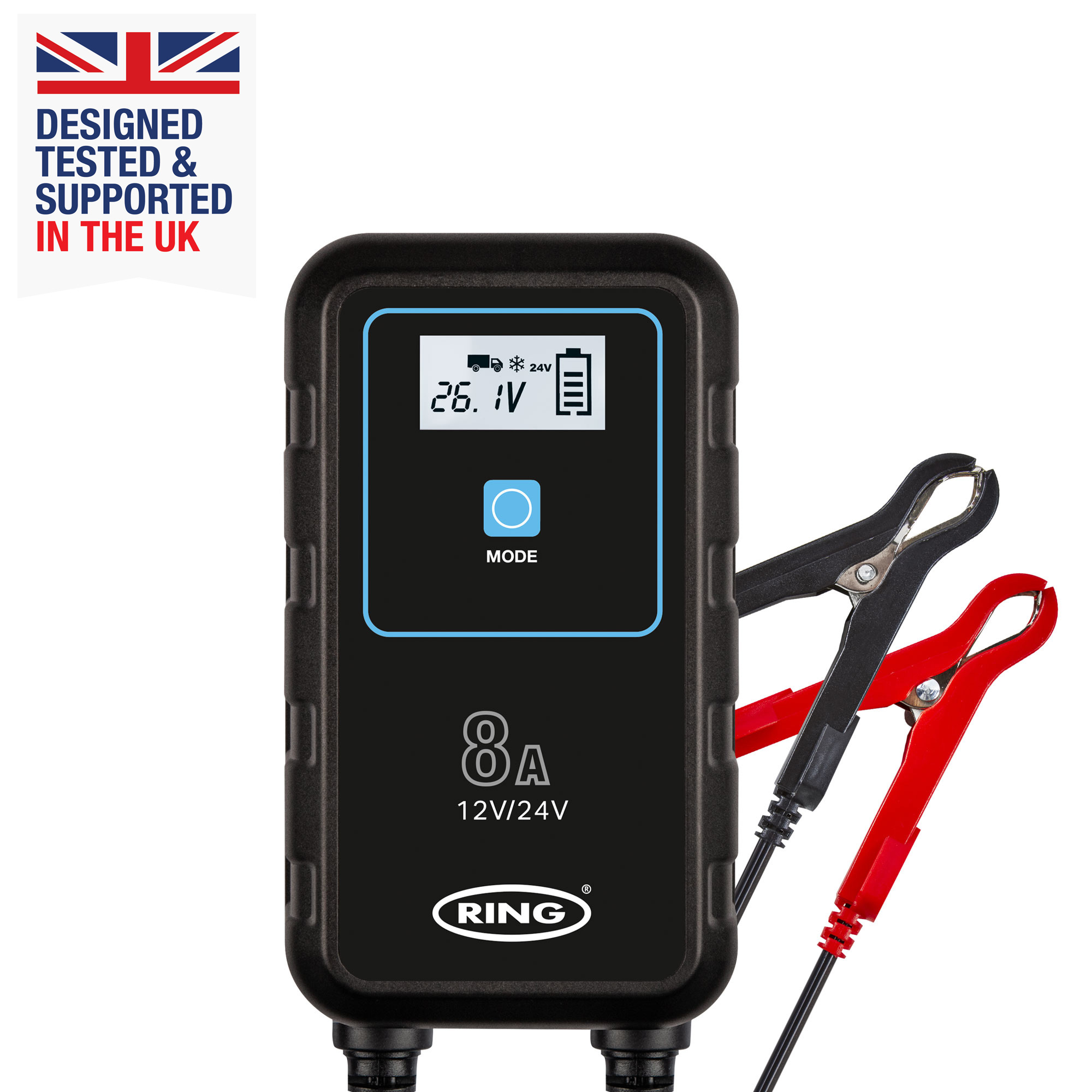
Ring RSC908 SMARTCHARGE 8 Car Battery Charger
Verdict
Premium role: Ring RSC908 SMARTCHARGE 8 Car Battery Charger is for buyers with a compatible larger or 24V battery setup who can justify 8A output. It is the only shortlisted model with documented 24V support and the highest stated output. Trade-off: Higher output and 24V capability add no value for an incompatible small battery and make mode selection more important. Check before buying: Confirm voltage, chemistry, capacity and the maker connection sequence; do not assume 8A is better for every battery.
Highlights
- It is the only shortlisted model with documented 24V support and the highest stated output.
Drawbacks
- Higher output and 24V capability add no value for an incompatible small battery and make mode selection more important.
Buyer fit
Best for
- Buyers with a compatible larger or 24V battery setup who can justify 8A output.
Not for you if
- Higher output and 24V capability add no value for an incompatible small battery and make mode selection more important.
Check before buying
- Confirm voltage, chemistry, capacity and the maker connection sequence; do not assume 8A is better for every battery.
Pick 4
Specialist
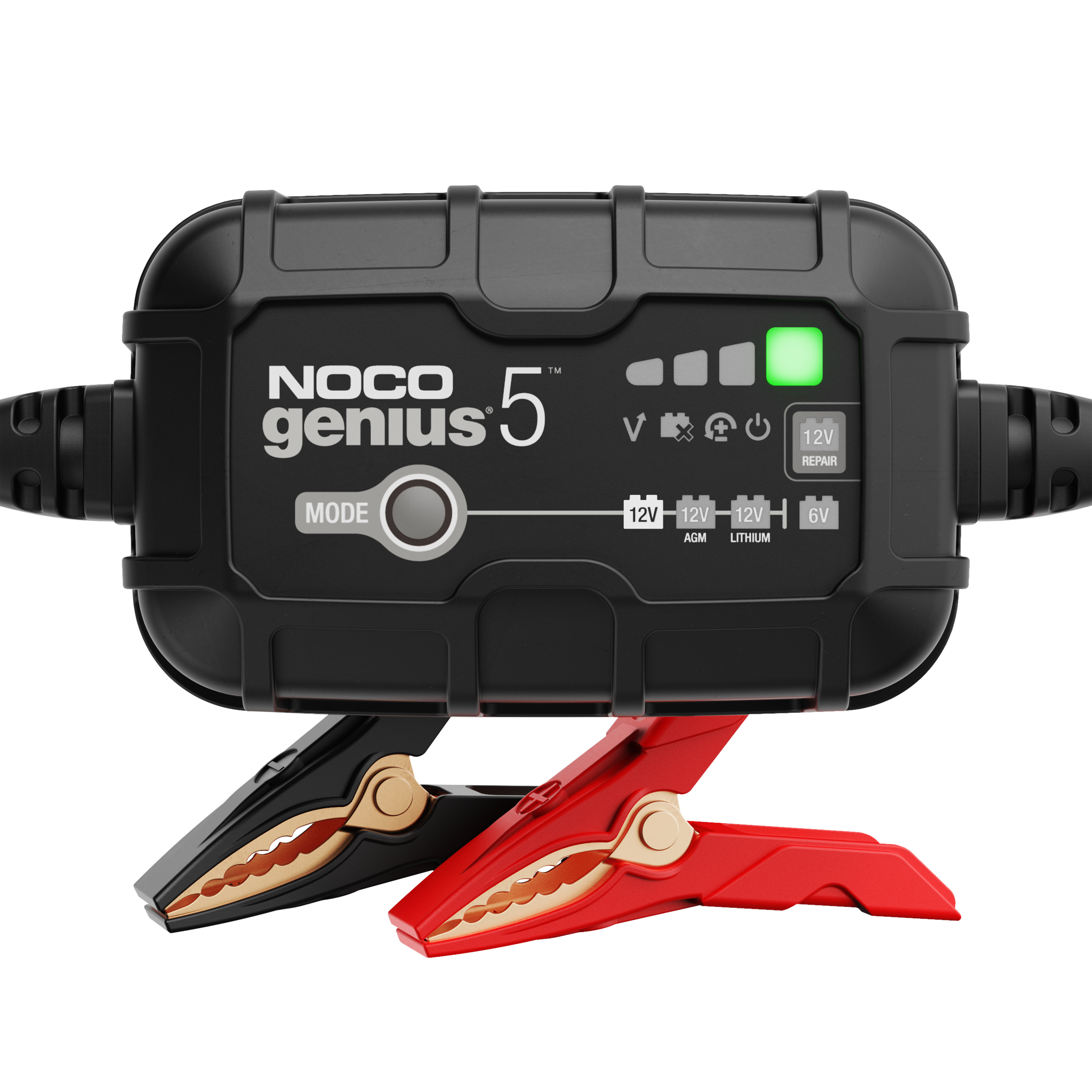
NOCO Genius 5 Car Battery Charger and Maintainer
Verdict
NOCO Genius 5 Car Battery Charger and Maintainer is for buyers who need one compact charger for supported 6V or 12V lead-acid and lithium-ion modes. NOCO publishes 5A output and explicit 6V/12V mode coverage across common lead-acid types and supported lithium-ion. Trade-off: Mode choice and lithium battery-management compatibility still require exact manual checks. Check before buying: Confirm the battery voltage, chemistry and BMS requirements before selecting a mode or leaving it connected.
Affiliate retailer link. Check current price, stock, delivery and returns before buying.
Highlights
- NOCO publishes 5A output and explicit 6V/12V mode coverage across common lead-acid types and supported lithium-ion.
Drawbacks
- Mode choice and lithium battery-management compatibility still require exact manual checks.
Buyer fit
Best for
- Buyers who need one compact charger for supported 6V or 12V lead-acid and lithium-ion modes.
Not for you if
- Mode choice and lithium battery-management compatibility still require exact manual checks.
Check before buying
- Confirm the battery voltage, chemistry and BMS requirements before selecting a mode or leaving it connected.
Top 4 comparison
Compare the useful differences, trade-offs and final checks side by side.
Before you compare
Check these first
- 1Read the battery label and vehicle manual for exact voltage, chemistry, capacity and connection sequence.
- 2Do not use a lead-acid-only charger mode on lithium, or a lithium mode on an unsupported battery.
- 3Use the charger only in the environment and ventilation conditions stated by its maker and inspect leads first.
Your four roles
1All-RounderCTEK MXS 5.0 UK Car Battery Charger and MaintainerDrivers with a compatible 12V lead-acid battery who want a documented charge and maintenance range.
Trade-off:It is not a lithium charger and does not support 6V or 24V batteries.
Not ideal for:It is not a lithium charger and does not support 6V or 24V batteries.
Check:Confirm the battery is supported 12V lead acid and within the maker capacity guidance before connecting.
2BudgetRing RSC904 SMARTCHARGE 4 Car Battery ChargerBuyers needing a compact 6V or 12V charger with documented modes for several common lead-acid types and supported lithium-ion.
Trade-off:Broad chemistry wording does not remove the need to confirm the exact lithium battery and battery-management requirements.
Not ideal for:Broad chemistry wording does not remove the need to confirm the exact lithium battery and battery-management requirements.
Check:Match the selected mode to the exact battery label and manual; do not infer universal lithium compatibility.
3PremiumRing RSC908 SMARTCHARGE 8 Car Battery ChargerBuyers with a compatible larger or 24V battery setup who can justify 8A output.
Trade-off:Higher output and 24V capability add no value for an incompatible small battery and make mode selection more important.
Not ideal for:Higher output and 24V capability add no value for an incompatible small battery and make mode selection more important.
Check:Confirm voltage, chemistry, capacity and the maker connection sequence; do not assume 8A is better for every battery.
4SpecialistNOCO Genius 5 Car Battery Charger and MaintainerBuyers who need one compact charger for supported 6V or 12V lead-acid and lithium-ion modes.
Trade-off:Mode choice and lithium battery-management compatibility still require exact manual checks.
Not ideal for:Mode choice and lithium battery-management compatibility still require exact manual checks.
Check:Confirm the battery voltage, chemistry and BMS requirements before selecting a mode or leaving it connected.
| Pick | Pick role | Best for | Avoid if | Key trade-off | Check before buying | Warranty/support status | Review/evidence basis | Retailer |
|---|---|---|---|---|---|---|---|---|
| 1. CTEK MXS 5.0 UK Car Battery Charger and Maintainer | All-Rounder | Drivers with a compatible 12V lead-acid battery who want a documented charge and maintenance range. | It is not a lithium charger and does not support 6V or 24V batteries. | It is not a lithium charger and does not support 6V or 24V batteries. | Confirm the battery is supported 12V lead acid and within the maker capacity guidance before connecting. | Check the current maker or retailer warranty, exclusions, return window and exact seller before purchase; no warranty outcome is asserted here. • Use the current maker instructions and support route for setup, care, compatibility and safe-use details. | CTEK MXS 5.0 UK official item 56-975 product page checked 2026-08-02: https://ctek.com/products/mxs-5-0-uk. Used for UK product identity and the listed objective specifications only. | Check winner price |
| 2. Ring RSC904 SMARTCHARGE 4 Car Battery Charger | Budget | Buyers needing a compact 6V or 12V charger with documented modes for several common lead-acid types and supported lithium-ion. | Broad chemistry wording does not remove the need to confirm the exact lithium battery and battery-management requirements. | Broad chemistry wording does not remove the need to confirm the exact lithium battery and battery-management requirements. | Match the selected mode to the exact battery label and manual; do not infer universal lithium compatibility. | Check the current maker or retailer warranty, exclusions, return window and exact seller before purchase; no warranty outcome is asserted here. • Use the current maker instructions and support route for setup, care, compatibility and safe-use details. | Ring RSC904 official product page checked 2026-08-02: https://www.ringautomotive.com/en/product/RSC904. Used for stable product identity and the listed objective specifications only. | No retailer link |
| 3. Ring RSC908 SMARTCHARGE 8 Car Battery Charger | Premium | Buyers with a compatible larger or 24V battery setup who can justify 8A output. | Higher output and 24V capability add no value for an incompatible small battery and make mode selection more important. | Higher output and 24V capability add no value for an incompatible small battery and make mode selection more important. | Confirm voltage, chemistry, capacity and the maker connection sequence; do not assume 8A is better for every battery. | Check the current maker or retailer warranty, exclusions, return window and exact seller before purchase; no warranty outcome is asserted here. • Use the current maker instructions and support route for setup, care, compatibility and safe-use details. | Ring RSC908 official product page checked 2026-08-02: https://www.ringautomotive.com/en/product/RSC908. Used for stable product identity and the listed objective specifications only. | No retailer link |
| 4. NOCO Genius 5 Car Battery Charger and Maintainer | Specialist | Buyers who need one compact charger for supported 6V or 12V lead-acid and lithium-ion modes. | Mode choice and lithium battery-management compatibility still require exact manual checks. | Mode choice and lithium battery-management compatibility still require exact manual checks. | Confirm the battery voltage, chemistry and BMS requirements before selecting a mode or leaving it connected. | Check the current maker or retailer warranty, exclusions, return window and exact seller before purchase; no warranty outcome is asserted here. • Use the current maker instructions and support route for setup, care, compatibility and safe-use details. | NOCO GENIUS5 official product page checked 2026-08-02: https://no.co/genius5. Used for stable product identity and the listed objective specifications only. | Check retailer price |
Choose this if / Avoid this if
Rule out poor-fit options before comparing finer details.
Avoid if
- Avoid this shortlist if you need an emergency jump starter, an EV traction-battery charger or a guaranteed recovery route for a damaged or frozen battery.
- Avoid any option unless the battery voltage, chemistry and capacity fall inside the exact model’s published guidance.
Dealbreakers
- Do not connect a charger unless the exact model’s voltage, supported chemistry and battery-capacity range match the battery and vehicle guidance.
- Pause if the retailer page shows a different regional model, missing connector or no clear seller and return route.
Check before buying
- Read the battery label and vehicle manual for exact voltage, chemistry, capacity and connection sequence.
- Do not use a lead-acid-only charger mode on lithium, or a lithium mode on an unsupported battery.
- Use the charger only in the environment and ventilation conditions stated by its maker and inspect leads first.
- Treat a charger or maintainer as different from a jump starter and never connect it to an EV traction battery.
Choose another shortlist if
- Use a jump-starter comparison if the immediate job is starting a stranded vehicle.
- Use the vehicle maker’s charging route if the battery is part of an EV or hybrid traction system.
- Use a battery-testing or replacement guide if the battery is damaged, frozen or repeatedly fails to hold charge.
Detailed buyer guidance
Start with the roadside-needs chooser if you are still choosing between battery maintenance, starting backup and a different roadside job. If the format is clear, compare the four products below and then work through How to match a car battery charger to voltage and chemistry before checkout.
Who this is for
This route is for a buyer who has read the battery label and vehicle manual and can identify the battery voltage, chemistry and capacity. It separates a lower-output mixed-chemistry route, a 12V lead-acid all-rounder, a higher-output 12V/24V route and a compact 6V/12V mixed-chemistry specialist. Those are ownership jobs, not a cheapest-to-most-expensive ladder.
Who this is not for
It is not for a buyer who does not yet know the battery facts, needs an emergency starting pack, or is dealing with a damaged, frozen or repeatedly failing battery. It does not cover an EV or hybrid traction battery. Pause rather than guessing a mode, and use the vehicle or battery maker’s route when the manual restricts charging or connection.
The four routes
CTEK MXS 5.0 UK Car Battery Charger and Maintainer — All-Rounder
Who it suits: Drivers with a compatible 12V lead-acid battery who want a documented charge and maintenance range.
Why it made the four: CTEK publishes 5A output, lead-acid chemistry coverage, temperature compensation and capacity guidance up to 110Ah charging and 160Ah maintenance.
Trade-off: It is not a lithium charger and does not support 6V or 24V batteries.
Check before buying: Confirm the battery is supported 12V lead acid and within the maker capacity guidance before connecting.
Ring RSC904 SMARTCHARGE 4 Car Battery Charger — Budget
Who it suits: Buyers needing a compact 6V or 12V charger with documented modes for several common lead-acid types and supported lithium-ion.
Why it made the four: Ring publishes 4A output, nine-stage charging, IP65 protection and clips plus O-ring connectors.
Trade-off: Broad chemistry wording does not remove the need to confirm the exact lithium battery and battery-management requirements.
Check before buying: Match the selected mode to the exact battery label and manual; do not infer universal lithium compatibility.
Ring RSC908 SMARTCHARGE 8 Car Battery Charger — Premium
Who it suits: Buyers with a compatible larger or 24V battery setup who can justify 8A output.
Why it made the four: It is the only shortlisted model with documented 24V support and the highest stated output.
Trade-off: Higher output and 24V capability add no value for an incompatible small battery and make mode selection more important.
Check before buying: Confirm voltage, chemistry, capacity and the maker connection sequence; do not assume 8A is better for every battery.
NOCO Genius 5 Car Battery Charger and Maintainer — Specialist
Who it suits: Buyers who need one compact charger for supported 6V or 12V lead-acid and lithium-ion modes.
Why it made the four: NOCO publishes 5A output and explicit 6V/12V mode coverage across common lead-acid types and supported lithium-ion.
Trade-off: Mode choice and lithium battery-management compatibility still require exact manual checks.
Check before buying: Confirm the battery voltage, chemistry and BMS requirements before selecting a mode or leaving it connected.
How to choose between them
- Read the battery label and vehicle manual for exact voltage, chemistry, capacity and connection sequence.
- Do not use a lead-acid-only charger mode on lithium, or a lithium mode on an unsupported battery.
- Use the charger only in the environment and ventilation conditions stated by its maker and inspect leads first.
- Treat a charger or maintainer as different from a jump starter and never connect it to an EV traction battery.
Why the 12V lead-acid route leads
CTEK MXS 5.0 UK Car Battery Charger and Maintainer is the first comparison point because the official UK item 56-975 page publishes 5A output, lead-acid chemistry coverage, temperature compensation and capacity guidance up to 110Ah charging and 160Ah maintenance. Recheck this recommendation if the model, supported chemistry, capacity range, connector set or UK plug changes.
Known limitations
The comparison does not independently measure charge time, recovery or long-term maintenance. Compatibility depends on the exact battery, vehicle guidance and charger mode. None of these products is a jump starter or an EV traction-battery charger.
How we chose and what to recheck
The category methodology explains the weighted criteria and exclusions, and links the dated information used for this comparison. Price, stock, ratings and review counts can change, so recheck them on the retailer page.
Compare next
Compare AGM-specific chargers only after confirming AGM on the label. Use the start-stop route when the battery is confirmed AGM or EFB in a start-stop vehicle, or the occasional-use maintainer route when the storage routine is the real decision.
What would change the winner?
The lead pick remains the right starting point only while this shortlist matches your priorities. Reconsider it when a different use case or fit requirement matters more.
How we chose
The checks behind the four picks
We compared current maker specifications for voltage, maximum output, supported battery chemistry, capacity guidance, maintenance mode, ingress protection and connection accessories. UK Shortlists did not charge-test batteries or verify recovery outcomes.
- Step 1: Exact battery compatibility: Voltage, chemistry and capacity are hard requirements, not optional features.
- Step 2: Charging and maintenance control: Stages, maintenance mode and temperature handling affect the intended job.
- Step 3: Connection and environment: Lead type, ingress protection, ventilation and maker procedure affect practical use.
- Step 4: Output and ownership fit: Higher amperage or 24V support is valuable only for a matching battery and workflow.
Disclosure
Last reviewed: 03/09/2026
UK Shortlists may earn a commission when you use some retailer links. This does not increase the price you pay.
As an Amazon Associate we earn from qualifying purchases.
Retailers cannot pay to change which products we recommend or their order.
Prices, stock, delivery and returns can change. Confirm the final details with the retailer before buying.
Read more about how UK Shortlists makes money, retailer checks, and how corrections are handled.
Who checked this shortlist?
- Written / compiled by:
- Outdoors & Mobility Desk
- Reviewed by:
- UK Shortlists Editorial Team
- Last reviewed:
- 03/09/2026
- Review basis:
- Key details checked
We compare published product information, retailer details and the buying criteria shown above. UK Shortlists does not currently publish claims based on first-party product use, laboratory testing or long-term testing.
FAQs & alternatives
Does this page claim first-party-use or laboratory verification?
No. This is a source-led comparison of current manufacturer and retailer information with dated specification checks; it does not present direct-use or laboratory findings.
Why are these labels based on charger capability rather than price?
Battery voltage and chemistry determine fit while live prices change. Each label states the verified operating role, so confirm your battery label and the current product manual before buying.
What should I do before opening a retailer page?
Read the battery label and vehicle manual, then use the companion guide to match voltage, chemistry, capacity and charging or maintenance duty.
Also consider
- Choose the 4A multi-chemistry charger if its supported 6V/12V modes and chemistry list match your batteries.
- Choose the 6V/12V mixed-chemistry option if one compact unit with explicit lead-acid and supported lithium-ion modes fits your batteries.
Newsletter
Want the next useful buying check?
Get occasional UK Shortlists updates for decisions like this. Unsubscribe at any time.
Related shortlists
- Best Car Battery Chargers for Start-Stop Cars (2026)
Use this related shortlist to compare trade-offs before finalising your Top 4 pick.
- Best Car Battery Chargers for AGM Batteries (2026)
Use this related shortlist to compare trade-offs before finalising your Top 4 pick.
- Best Battery Maintainers for Occasionally Used Cars (2026)
Use this related shortlist to compare trade-offs before finalising your Top 4 pick.
- How to match a car battery charger to voltage and chemistry
Use the practical checklist before choosing a product.
- Car Battery Care category
Return to the category decision map.